Medieval and Early Modern Studies Spring School 2026

Materiality, Material Culture and Materialist Approaches

This Spring School is organised by Ghent University (Doctoral Schools), the University of Groningen, the Huizinga Institute and the Dutch Research School for Medieval Studies in cooperation with different research groups in the Low Countries. The main aim of this initiative is to stimulate contacts and exchange between PhD candidates and ReMa students in the interdisciplinary field of Medieval and Early Modern Studies bringing them together around a specific theme. The focus for this edition will be on materiality and material culture.

Topic

Material studies is a dynamic and rapidly evolving field in the study of the Middle Ages and the Early Modern Period. It explores the materiality of “objects” (broadly defined), drawing on various disciplines, such as book history, art history, history of science, archaeology and archaeometry. This Spring School examines technical methods, cultural uses of objects and human–object interactions, from daily use to ritual. Materialist and ecocritical perspectives are specifically addressed. Through lectures, workshops and pitches, participants will actively engage with varied approaches to materiality and material culture in historical contexts.

Programme

Session I: Walk through Ghent: Urban Archaeology with Geert Vermeiren (City of Ghent)

Session II & III: – Materialist Thought and Approaches with Laura Georgescu (University of Groningen) and Adam Hansen (Northumbria University)

Session IV & V: The Materiality of Cultural Objects with Marieke Hendriksen (Huygens Institute, Amsterdam), Maximiliaan Martens (Ghent University) and Youri Desplenter (Ghent University)

Session VI & VII : Material Culture with Maxime Poulain (University of Tübingen) and Maïka De Keyzer (KU Leuven)

Session VIII & IX:  Natural Environment and Sustainability with Marjolijn Bol (Utrecht University) and Sander Govaerts (Ghent University)

Registration

PhD students and ReMa students are invited to register for this course before 4 February 2026 through the following link: https://forms.gle/T7YHmVkAKXqXoN9BA  Please note that there is a limited number of places available for this course. After the deadline you will soon receive more information about whether your registration can be confirmed or not. Some of the participating graduate/doctoral schools will cover tuition and lodging for their participating members (please wait for more information after your registration). Students working on Antiquity, or the Modern Period can attend as well but please note that this course will focus mainly on the Middle Ages and the Early Modern Period.

Organising institutions and partners

This Spring School is organised by Ghent University (Doctoral Schools), the University of Groningen, the Huizinga Institute and the Research School for Medieval Studies in cooperation with the following research groups: the Groningen Research Institute for the Study of Culture (Rijksuniversiteit Groningen), the Group for Early Modern Studies (UGent), the Henri Pirenne Institute for Medieval Studies (UGent), the Centre for Urban History (University of Antwerp) the Amsterdam Centre for Studies in Early Modernity (UvA), the Institute for Early Modern History (UGent-VUB) and the Onderzoeksgroep Nieuwe Tijd (KU Leuven).

Organising committee

Marrigje Paijmans (UvA), Elizabeth Merrill (UGent), Bart Ramakers (RUG), Stefan Meysman (UGent), Maïka De Keyzer (KU Leuven), Marlise Rijks (VUB/UGent), Estel van den Berg (UGent) and Kornee van der Haven (UGent).
Talk: Women and Language in late Renaissance Florence by Dr. Eleonora Serra

This month GEMS is organising a talk by Dr. Eleonora Serra on women and language in late Renaissance Florence.

Women’s activity as letter writers in Renaissance Italy has come to the fore across a range of fields, including palaeography and cultural, social, and literary history. When it comes to linguistics, research has largely concentrated on the epistolary practice of individual women, while few attempts have so far been made to provide a more comprehensive analysis of early modern women’s epistolary language. However, private letters – both a privileged source to reconstruct language history, and the genre in which women’s participation was wider – represent an ideal locus to reconstruct the language of early modern women. In this talk, I present some results from a project that analyses a corpus of private, autograph letters by writers from over thirty families of the Florentine patriciate (1540–1609), focusing on a diverse range of features (morpho-syntactic features, formulae, forms of address). Drawing on unedited archival material, and adopting historical sociolinguistic approaches that have not been widely applied in the Italian context, this study seeks to compare men’s and women’s language in late Renaissance Florence.

Eleonora is a linguist who studies topics from the early modern period, with strong connections to history, culture, and literature. She has completed an FWO Junior Postdoctoral Fellowship and a one-year fellowship at Villa I Tatti – The Harvard Center for Renaissance Studies, and has just started her FWO Senior Fellowship at Ghent University.

Belvedere Lecture and Inaugural Lecture by Prof. Roland Greene

Please join us for Prof. Roland Greene’s Inaugural Francqui Lecture and the 2025 Belvedere Lecture: New Perspectives on Early Modern Studies.

Greene’s lecture will trace the decline of universalism: the idea that certain themes, experiences, or values in literature are common to all humans, transcending specific cultural, historical, or geographical contexts. This doctrine ruled the study of literature until about 75 years ago. Its disappearance made possible new canons of experimental, ethnic, and Indigenous writing, but left literary studies with a crisis of authority—and a diminished place in public culture—that remains the topic of countless jeremiads. After sketching a provocative history of this transformative episode in the life of a discipline, Prof. Greene will offer ideas toward the rebuilding of literary criticism’s authority on a sounder basis than what it was established on—in effect, remaking its foundation with a new sense of ethics and justice.

The lecture will be followed by a Q&A with the audience and a reception.

Register before 04-03-2026 18:05.

Prof. Roland Greene is the Mark Pigott KBE Professor, Anthony P. Meier Family Professor of the Humanities, a Professor of English and Comparative Literature at Stanford University, and Director of the Stanford Humanities Center. During 2026, he will be a Francqui International Chair at Ghent University.

His research and teaching are concerned with the early modern literatures of England, Latin Europe, and the transatlantic world, and with poetry and poetics from the Renaissance to the present. His most recent book is Five Words: Critical Semantics in the Age of Shakespeare and Cervantes (Chicago, 2013). His other books include Unrequited Conquests: Love and Empire in the Colonial Americas (Chicago, 1999); and Post-Petrarchism: Origins and Innovations of the Western Lyric Sequence (Princeton, 1991). Greene is the editor with Elizabeth Fowler of The Project of Prose in Early Modern Europe and the New World (Cambridge, 1997), and he is editor in chief of the fourth edition of the Princeton Encyclopedia of Poetry and Poetics (2012).

In 2015-16 he served as President of the Modern Language Association. His theme for the 2016 Annual Convention in Austin, Texas was Literature and Its Publics: Past, Present, and Future. At Stanford Greene is co-chair and founder of two research workshops in which most of his Ph.D. students participate. Renaissances brings together early modernists from the Bay Area to discuss work in progress, while the Poetics Workshop provides a venue for innovative scholarship in the broad field of international and historical poetics. Greene has taught at Harvard and Oregon, where for six years he was chair of the Department of Comparative Literature. He is a member of the American Academy of Arts and Sciences.


The Belvedere Lecture: New Perspectives in Early Modern Studies (https://www.belvederelecture.ugent.be) is a joint initiative of various research groups at Ghent University, including the Institute for Early Modern History, the Sarton Centre for History of Science, the Group for Early Modern Studies (GEMS), the Institute for Legal HistoryTHALIA and RELICS

Cultures of Consumption 1500-1800: Products, Desire and Imagination

On 15 & 16 January of 2026, an international workshop will be organised in Ghent (Belgium) on cultures of consumption, focusing on the relation between products, desire and imagination in Europe from 1500-1800.

In our contemporary world, consumers are bombarded daily with advertisements to buy products. Most advertisements in modern media are not limited to the utility of the product as their main selling point.  They instead sell the fantasy that the consumer’s life is elevated by buying the advertised product. Consumption cannot solely be defined as the opposite of production, and is instead an autonomous force, intrinsically tied to the imagination and identity of the consumer. How consumerism and consumer culture emerged has been a fruitful topic of debate in recent scholarship on the rise of consumer society in Europe. Scholars like David Graeber have challenged the definition of consumption as the opposing force to production, while steering towards a more critical analysis of consumption that also involves the link between consumption and cultural imagination.

In the critical analysis of the origins of consumption and consumer culture, such as Graeber’s, much scholarly attention has been paid to early modernity. In early usages of the word in French and English starting from the fourteenth century consumption was linked to disease and the wasting of material goods. The desires and fears of early modern people concerning consumption and objects of desire were explored and portrayed in art, theatre and science. These desires and anxieties were rooted in class, gender and colonial relations. ‘Cultures of consumption’ therefore is defined broadly within this workshop. We are particularly focused, however, on the aspect of cultural imagination and the ways in which this imagination engages with the desire to purchase and possess products.

We invite researchers to reflect on this dimension of imagination and its interaction with the affective aspects of consumption from a variety of media perspectives. This may include insights drawn from the study of literature, theatre, visual art, and early examples of advertising. A range of academic disciplines can be brought to bear on this topic, including cultural history, history of emotions/affect studies, theatre studies, socio-economic history, philosophy, and material studies. This international workshop at Ghent University aims to bring the many divergent approaches to the history of consumption and desire together.

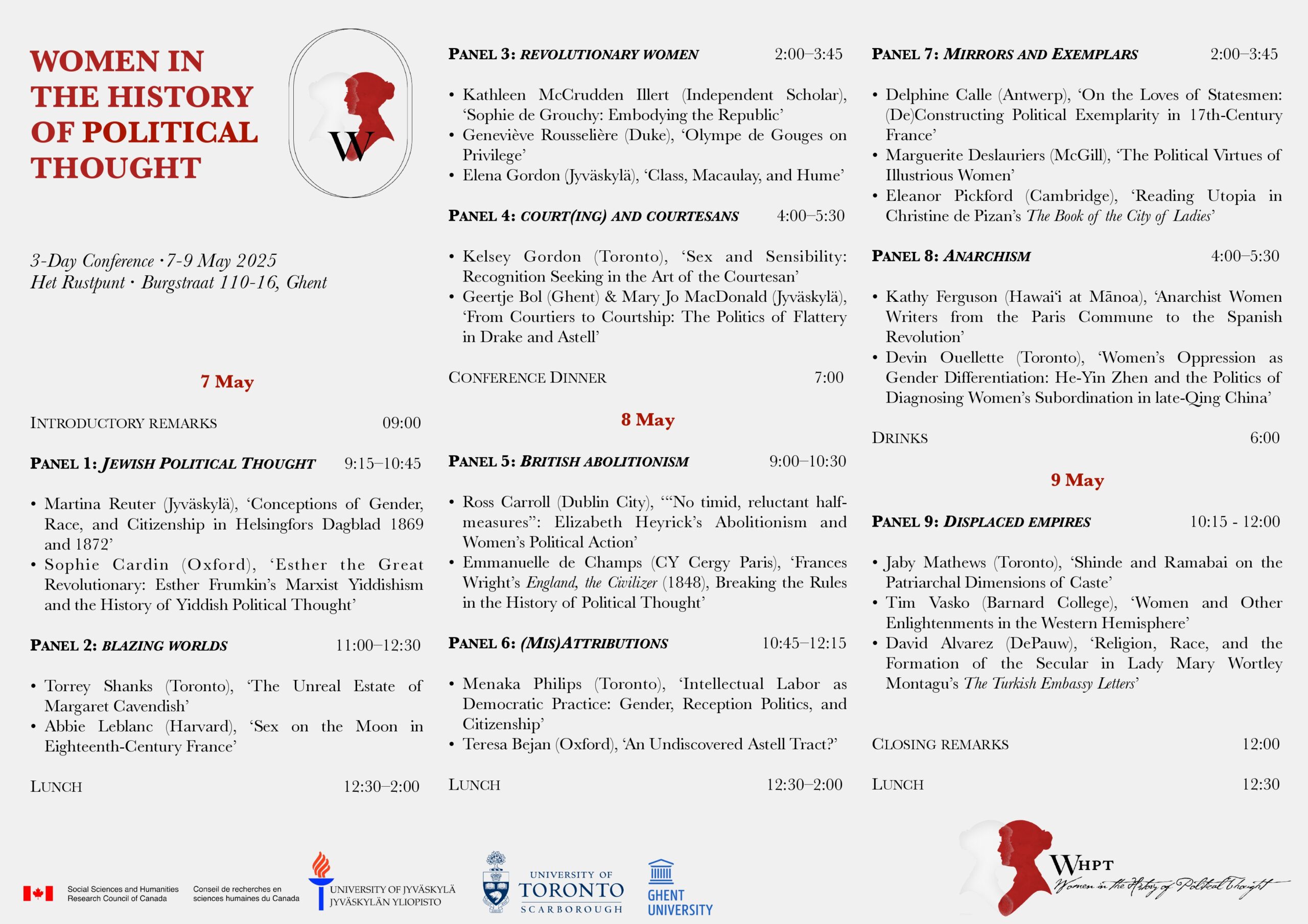
Conference: Women in the History of Political Thought

More and more exciting research is being produced by scholars of political theory and related fields––such as political science, history, and political philosophy––exploring the contributions of women to the history of political thought. This three-day WHPT conference is an important step towards bringing these scholars together, with the aim of fostering new intersections and inspiring future research.

Find the full conference program below.

This conference is organized by Torrey Shanks (University of Toronto), Mary Jo MacDonald (University of Jyväskylä), and Geertje Bol (Ghent University). It is generously funded by Social Science and Humanities Research Council of Canada, the Strategic Institutions Partnerships grant from Ghent University, the University of Toronto Scarborough Campus, and the Gender in Renaissance and Early Modern Philosophy project at the University of Jyväskylä.

Visit the website for more information.

Talk: New Research Perspectives on Italian Vernacular Rhetorics of the 16th Century by Dr. Elena Bilancia

GEMS is organising a talk by Dr. Elena Bilancia on ‘New Research Perspectives on Italian Vernacular Rhetorics of the 16th Century’.

The development of vernacular rhetorical theory played a key role in the intellectual culture of the Italian and European Renaissance. During the 16th century, the growing need to establish an autonomous set of rhetorical principles, crafted by (and for) literary professionals rather than university professors, extended beyond humanistic pedagogy and the formation of the ideal vir bonus dicendi peritus. It also addressed the changing role of intellectuals and their evolving relationship with cultural, political, and religious institutions, especially in the turbulent period between the end of the Italian Wars and the onset of the Counter-Reformation. Italian intellectuals made an original contribution to rhetorical theory not only through their exegetical work on ancient texts but also by exploring the potential of the vernacular language in the extra-university cultural circuits. It was particularly within the Infiammati Academy of Padua that a defence of the practical and civic function of elocutio was elaborated. The objective of Elena Bilancia’s research is therefore to identify the specific cultural projects that contributed to the foundation of an Italian vernacular rhetoric within the complex framework of European humanisms.

Elena Bilancia obtained her PhD in Philology and in Italian Studies from the universities of Naples Federico II and Paris 8 Vincennes – Saint-Denis. She is currently a research fellow at the Scuola Superiore Meridionale and a contract lecturer in Italian Literature at the Department of Humanities at Federico II. Her research interests focus on vernacular dialogue production and Renaissance lyric poetry. She has worked on authors such as Boccaccio, Machiavelli, and Torquato Tasso. In 2024, she published the monograph Il dialogo in volgare. Forme dell’argomentazione retorica nel XVI secolo with Bit&s.

Talk: Debating Private Censorship and Family Networks from Florence to Flanders: Lodovico Guicciardini’s Letters and the Publication of Francesco Guicciardini’s “Ricordi” by Dr. Jonathan Schiesaro

GEMS is organising a talk by Dr. Jonathan Schiesaro onDebating Private Censorship and Family Networks from Florence to Flanders: Lodovico Guicciardini’s Letters and the Publication of Francesco Guicciardini’s “Ricordi”’.

This talk explores the epistolary and editorial activity of Lodovico Guicciardini (1521-1589) between the events surrounding the publication of the first edition of Francesco Guicciardini’s History of Italy (1561), edited by Lodovico’s cousin Agnolo di Girolamo (1525-1581), and the Antwerp edition of the Ricordi (1585). Through a close reading of his correspondence and early printed materials within the Flemish context, the talk examines how private censorship and family networks shaped the reception of Italian historical culture and political thought on the periphery of the Counter-Reformation.

Jonathan Schiesaro (PhD, University of Zurich) is a research fellow of the Irish Research Council at Trinity College Dublin, where he works on a project focused on the transmission and manipulation of documentary heritage within Florentine patrician families (including the Vasari, Bandinelli, Buonarroti, Machiavelli, Guicciardini, and Ammirato) under the early Grand Dukes of Tuscany. His main research interests include Renaissance art treatises, memory writing, and historiography. He published the monograph Baccio Bandinelli e le anatomie degli scartafacci: il “Libro del disegno”, l’archivio di famiglia e la questione del “Memoriale” (Berlin: De Gruyter, 2023).

Roundtable: “Literary Afterlives, from the Eighteenth Century to the Present”

This interdisciplinary roundtable will explore the rich and varied afterlives of eighteenth- and nineteenth-century literature in contemporary media, culture, and criticism. A panel of leading scholars in literary studies will delve into how historical figures and forms—from seafaring pirates and biting satirists to queer protagonists and Enlightenment thinkers—continue to shape cultural narratives today. Our discussion will examine the reimagining of early modern tropes in contemporary literature, film, and television; the resonances of eighteenth-century satire in postcolonial thought; and the legacy of Enlightenment ideals in current debates on religious toleration. By interrogating how the past is adapted and reframed in the present, the roundtable promises to offer fresh insights into literature’s role in navigating ongoing conversations around gender, identity, colonialism, and belief.

The event will conclude a lively Q&A session and an informal reception to encourage further exchange.

Speakers:
Manushag Powell, Arizona State University
David Alvarez, DePauw University
Ros Ballaster, Oxford University
Helen Deutsch, UCLA

Chair: Andrew Bricker, UGent

Talk: ‘The Map After the Shipwreck: Angelo Poliziano and the Encyclopedic Ideal’ by Dr. Francesco Caruso

GEMS is hosting a talk by Dr. Francesco Caruso on Angelo Poliziano and the encyclopedic ideal.

For early humanists, engaging with the classics was an integral part of their intellectual activity. The inventory of what remained after the shipwreck of the ancient world became the battlefield where “the best minds of three generations” clashed, in the attempt of incorporating this or that author to their range of expertise. In the late 1480s, during the opening of the academic year at the University of Florence, the Tuscan poet and humanist Angelo Poliziano (1454–1494) delivered a prologue, the Panepistemon. This work implicitly certified that the efforts of his predecessors had been short-sighted. Not only did they demonstrate a limited or non-existent knowledge of the Greek language, but they also focused on a narrow range of ancient authors, mostly poets, historians, and orators. For Poliziano, this highlighted the need to create a vast encyclopedic project to reorganize the entire intellectual heritage of Greek and Latin output, including, among others, philosophy, sciences, and the law.

Dr. Francesco Caruso has a double background, legal and literary. He graduated from the School of Law in Palermo and holds a MA from University of Pennsylvania and a PhD from Johns Hopkins University. His main areas of  research are the Italian Quattrocento, Neo-Latin literature and intellectual history. He has primarily published on Boccaccio and Poliziano, to whose intellectual biography he devoted his dissertation. He currently teaches Italian language and literature in the International Baccalaureate Program at the Gonzaga Campus in Palermo and works also as a professional translator. His current projects concern Cristoforo Landino’s Disputationes Camaldulenses but he is also conducting archival research on the Hortus Catholicus, one of Europe’s earliest botanical gardens.

Talk: Religion, Race, and the Formation of the Secular in Lady Mary Wortley Montagu’s The Turkish Embassy Letters by David Alvarez

GEMS is hosting a talk by Prof. Dr. David Alvarez (DePauw University) on religion, race, and the formation of the secular in Lady Mary Wortley Montagu’s The Turkish Embassy Letters.

Europe and Islam, feminism and the veil, orientalism, empire, and race: there are few works of eighteenth-century British literature that seem as topical as Lady Mary Wortley Montagu’s The Turkish Embassy Letters (1763). One of the first women to describe her travels to the Ottoman Empire, and one of the first Europeans to visit women-only spaces there, Montagu praises many aspects of Ottoman culture and society, most notably the liberty of the “Turkish ladies,” who are, she claims, “(perhaps) freer than any ladies in the universe.” Hailed in the last thirty years as a proto-feminist Enlightenment effort to overcome the East/West divide, her literary account of her travels from 1716-18 through Europe, Africa, and the Ottoman Empire has been seen as promoting “peaceful cosmopolitan intercultural exchange” and heralding “the advent of European secularism.” The Letters’ topicality, however, has unfortunately had the effect of limiting scholars’ attention to Montagu’s descriptions of the Ottoman empire, which make up less than half the book. By ignoring her account of her travels through Roman Catholic Europe, we miss seeing how Montagu represents Ottoman alterity by projecting outward from England a distinction that is internal to Christianity: the divide between Roman Catholicism and Protestantism. This divide in her work is more fundamental than that between East and West. It grounds not only her criticisms of Roman Catholic Baroque Europe as benighted, backwards, and absolutist but also her celebration of the Ottomans for their polite sociability, tolerant cosmopolitanism, and liberty for women. If it is through these binaries that her work contributes to the formation of the secular, they also explain how Montagu conceptualizes race and anti-Black racism in her letters about North African women, who are represented as having more in common with Roman Catholics than Ottoman Muslims.

Prof. Dr. David Alvarez (DePauw University) is a Fulbright scholar this year at Ghent University, and is currently finishing a book manuscript on “Imagining Global Religion: Secularity, Religious Toleration, and Empire in the English Enlightenment.” He has published internationally on eighteenth-century English literature and philosophy, focusing on religious toleration, aesthetics, and the Third Earl of Shaftesbury. With Prof. Alison Conway, he has also edited a book collection of essays, Imagining Religious Toleration: A Literary History of an Idea, 1600-1830. His course on “Staging World Religions and the Formation of the Secular in Restoration Drama” builds on his book project by examining how Restoration drama contributes to changes in the meaning of “religion” and to what ethical, secular, and imperial ends.