Call for Papers Jaarboek De Achttiende Eeuw: ‘Geld en krediet: van John Law tot Greshams Law’

English version below

Geld en krediet zijn twee kanten van dezelfde medaille: vertrouwen. Maar beide zijn ook betaalmiddelen. Hoe dat in het verleden functioneerde hing af van sociale en institutionele contexten. Zo tuigde de Schotse financier John Law in Frankrijk een complex systeem op van leningen en papiergeld gedekt door goud en zilver, dat in 1720 compleet instortte toen het publieke vertrouwen wegviel. Krediet was echter geen uitzondering, maar een alledaags onderdeel van het economische verkeer. Dat blijkt bijvoorbeeld uit de uitbetaling van zeeliedenlonen, waarbij logementhouders zekerheid voor hun betaling zochten. Ook contante betalingen tussen winkeliers en klanten waren niet vanzelfsprekend, terwijl in de vroegmoderne tijd een grote verscheidenheid aan munten door elkaar circuleerde. Wat de waarde van die munten precies was en of men daarop kon vertrouwen, was geen vaststaand gegeven.

Voor het themadossier van 2027 verwelkomt de redactie van De Achttiende Eeuw bijdragen die in brede zin op het thema ‘geld en krediet’ ingaan. Onderwerpen kunnen variëren van de rol van bankiers, geldschieters en de media tot die van de overheid als producent van muntgeld en regulerend orgaan dat economische stabiliteit en vertrouwen bevorderde, toezicht hield op het economische verkeer en fraude bestreed. Bijdragen over financiële crises (zoals de Mississippibubbel of de South Seabubbel, waaraan de naam van John Law nauw verbonden blijft) en speculatiedrift zijn welkom. Te denken valt ook aan de wereldwijde verspreiding van muntgeld. Zo gold de Hollandse gulden dankzij het stabiele zilvergehalte als standaardmunt in het internationale betalingsverkeer en functioneerden Spaanse realen lange tijd als belangrijkste betaalmiddel voor Europeanen in Azië. Naast dat zilvergeld vond ook Europees kopergeld zijn weg naar Aziatische markten, wat leidde tot de monetisering van de economie. Wat leert dit ons over vroege vormen van globalisering of over de universele waarden van geld, krediet en vertrouwen? Tot slot kijkt de redactie uit naar cultuurhistorische bijdragen over economie, geld en krediet en hun weerslag in de literaire, wetenschappelijke (denk aan Adam Smith) en kunsthistorische wereld van de achttiende eeuw.

Abstracts met voorstellen voor artikelen (max. 300 woorden, met korte bio van de auteur) graag toezenden vóór 1 augustus 2026, aan gastredacteur Alberto Feenstra (penningmeester@18e-eeuw.nl) en jaarboek@18e-eeuw.nl. Van de geselecteerde voorstellen worden de volledige artikelen van maximaal 6.000 woorden verwacht tegen 1 februari 2027. De artikelen worden aan redactionele peer review onderworpen.


Money and credit are two sides of the same coin: trust. But both are also means of payment. How this functioned in the past depended on social and institutional contexts. For instance, the Scottish financier John Law set up a complex system in France of loans and paper money backed by gold and silver, which completely collapsed in 1720 when public trust fell. Credit was not an exception, but an everyday part of economic transactions. This is evident, for example, from the payment of sailors’ wages, where innkeepers sought security for their payment. Cash payments between shopkeepers and customers were also not a given, while in the early modern period a wide variety of coins circulated. What the exact value of those coins was, and whether one could trust them, was not fixed notion.

For the 2027 thematic dossier, the editors of De Achttiende Eeuw welcome contributions that broadly interact with the topic of ‘money and credit’. Topics can range from the role of bankers, lenders, and the media, to that of the government as a producer of coinage and a regulatory body that promoted economic stability and confidence, supervised economic activity, and combated fraud. Contributions regarding financial crises (such as the Mississippi Bubble or the South Sea Bubble, with which John Law remains closely associated) and speculation are welcome. Consideration should also be given to the global spread of coinage. For instance, the Dutch guilder served as the standard currency in international payments thanks to its stable silver content, and Spanish reales functioned for a long time as the primary means of payment for Europeans in Asia. In addition to this silver currency, European copper currency also found its way to Asian markets, leading to the monetisation of the economy. What does this teach us about early forms of globalisation or about the universal values ​​of money, credit, and trust? Finally, the editors look forward to cultural-historical contributions on economics, money, and credit, and their impact on the literary, scientific (think of Adam Smith), and art-historical world of the eighteenth century.

Please submit abstracts with article proposals (max. 300 words, with a brief biography of the author) before 1 August 2026 to guest editor Alberto Feenstra (penningmeester@18e-eeuw.nl) and jaarboek@18e-eeuw.nl. Full articles of a maximum of 6,000 words from the selected proposals are expected by 1 February 2027. The articles will be subject to editorial peer review.

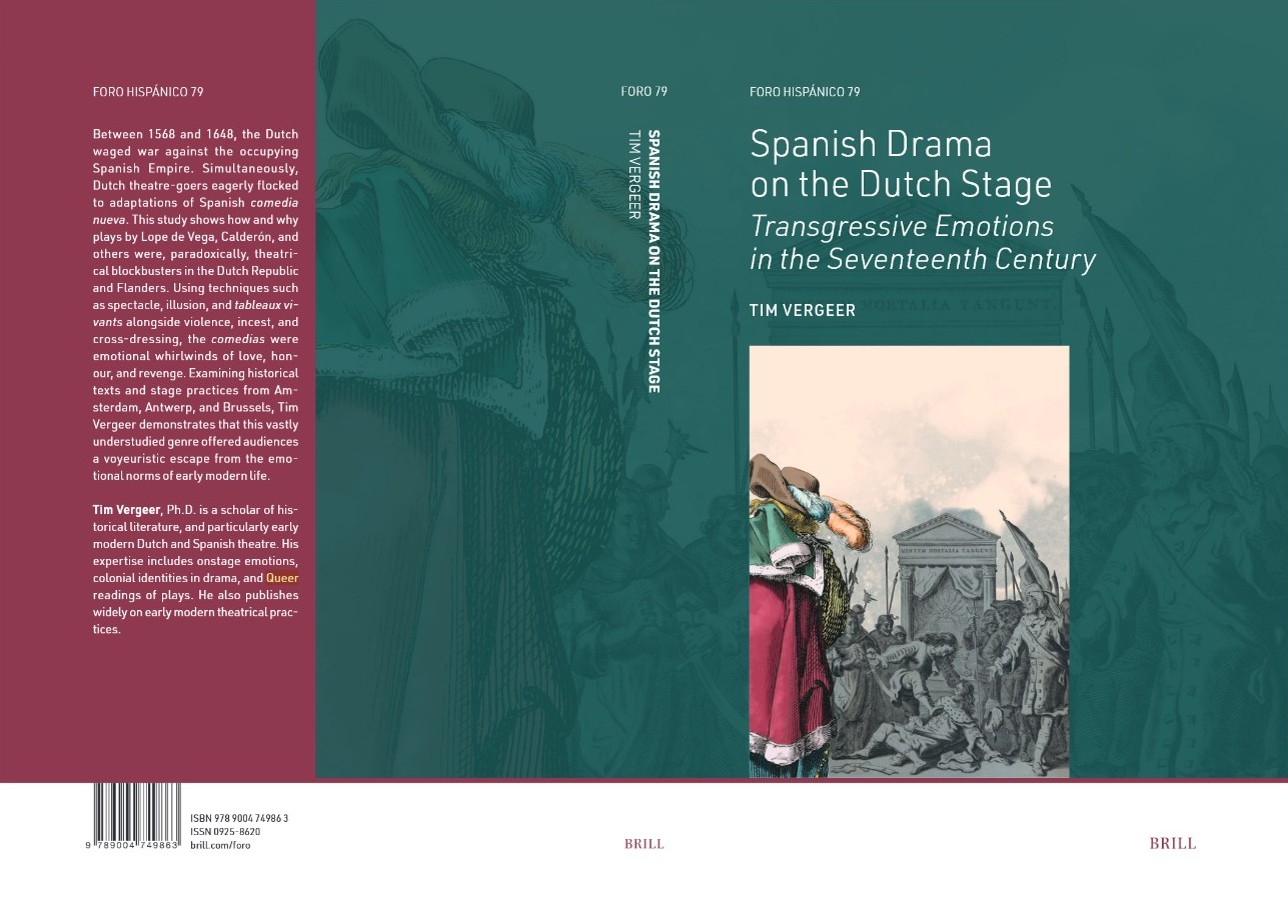
 

Double Book Presentation by Dr. Tim Vergeer and Dr. Britt Dams: Early Modern Dutch Literature in International Contexts

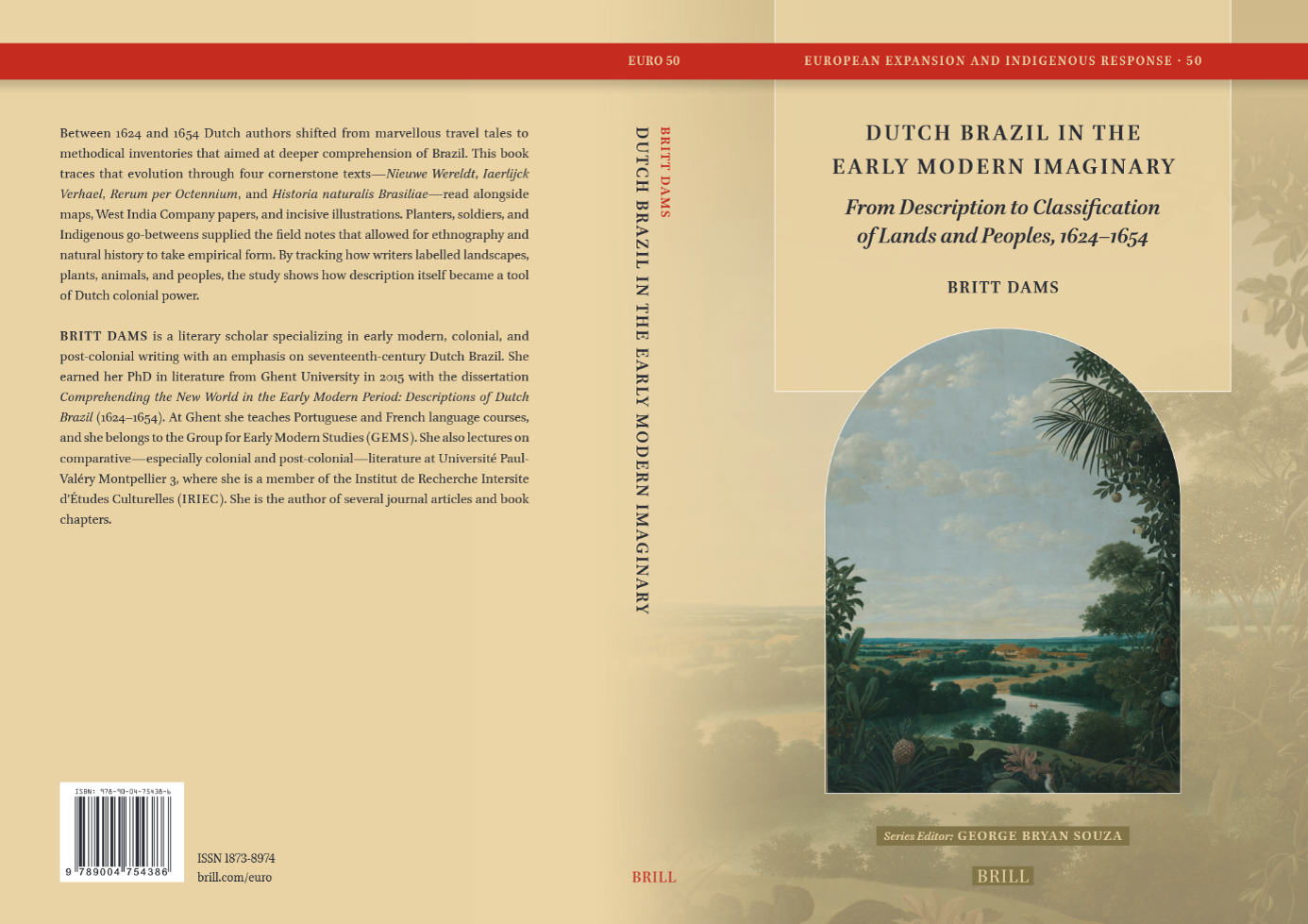
GEMS warmly invites you to the book presentation of two recently published volumes on early modern Dutch literature in international contexts: Spanish Drama on the Dutch Stage: Transgressive Emotions in the Seventeenth Century (Brill, 2025) by Dr. Tim Vergeer, and Dutch Brazil in the Early Modern Imaginary: From Description to Classification of Lands and Peoples, 1624-1654 (Brill, 2026) by Dr. Britt Dams.

Monday 22nd of June 2026 at 4pm
Camelot Meeting Room (room 3.30)
Blandijnberg 2, Campus Boekentoren

Tim Vergeer, Spanish Drama on the Dutch Stage: Transgressive Emotions in the Seventeenth Century (Brill, 2025)

Between 1568 and 1648, the Dutch revolted against the occupying Spanish Empire. Simultaneously, Dutch theatregoers eagerly flocked to adaptations of Spanish comedia nueva. This study shows how and why plays by Lope de Vega, Calderón, and others were, paradoxically, theatrical blockbusters in the Dutch Republic and Flanders. Using techniques such as spectacle, illusion, and tableaux vivants alongside violence, incest, and cross-dressing, the comedias were emotional whirlwinds of love, honour, and revenge. Examining historical texts and stage practices from Amsterdam, Antwerp, and Brussels, Tim Vergeer demonstrates that this vastly understudied genre offered audiences a voyeuristic escape from the emotional norms of early modern life.

About the author

Tim Vergeer, Ph.D., is a scholar of historical literature and, particularly, early modern Dutch and Spanish theatre. His expertise includes onstage emotions, colonial identities in drama, Queer readings of plays. He also publishes widely on early modern theatrical practices. More recently, he has been exploring the feminine perspective in Dutch poetry. He is a visiting professor at Ghent University.


Britt Dams, Dutch Brazil in the Early Modern Imaginary: From Description to Classification of Lands and Peoples, 1624-1654 (Brill, 2026)

Between 1624 and 1654, Dutch representations of Brazil evolved from wonder-filled travel narratives to increasingly systematic forms of observation and classification. Drawing on four key texts—Nieuwe WereldtIaerlijck VerhaelRerum per Octennium in Brasilia, and Historia naturalis Brasiliae—alongside maps, West India Company records, and illustrations, this study traces the emergence of new ways of describing the colonial world. It shows how information gathered by planters, soldiers, artists, and Indigenous intermediaries shaped the classification of landscapes, plants, animals, and peoples, transforming description into a powerful tool of colonial knowledge and governance in Dutch Brazil.

About the author

Britt Dams is a literary scholar specializing in early modern, colonial, and postcolonial literature, with a particular focus on seventeenth-century Dutch Brazil. She received her PhD in Literature from Ghent University in 2015 with a dissertation entitled Comprehending the New World in the Early Modern Period: Descriptions of Dutch Brazil (1624–1654). She teaches Portuguese and French at Ghent University’s Language Centre and is affiliated with the Ghent Centre for Early Modern Studies (GEMS). She also teaches comparative literature, with a special emphasis on colonial and postcolonial studies, at Université Paul-Valéry Montpellier 3, where she is a member of the Institut de Recherche Intersite d’Études Culturelles (IRIEC). She has published widely on early modern travel writing, colonial discourse, and representations of Brazil in journal articles and edited volumes.

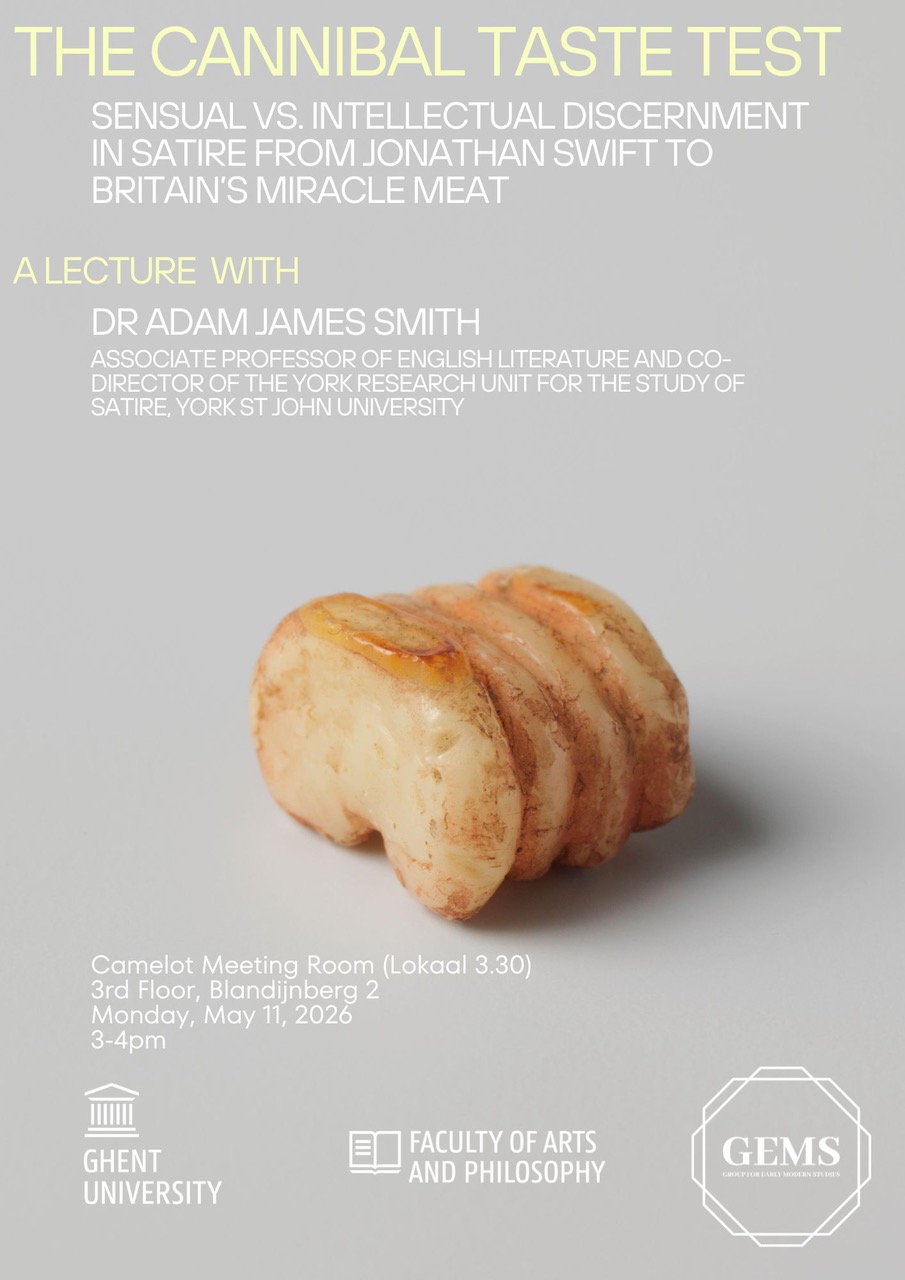
Lecture by Dr Adam James Smith: “The Cannibal Taste Test: Sensual vs. Intellectual Discernment in Satire from Jonathan Swift to Britain’s Miracle Meat”

Camelot Meeting Room (Lokaal 3.30)
3rd Floor, Blandijnberg 2
Monday, May 11, 2026, 3-4 pm

This presentation examines the trope of cannibalism in satire as a means of interrogating the unstable boundary between sensual and intellectual taste. In the eighteenth century, “taste” denoted both physical gustation and aesthetic or moral discernment, a duality captured in Voltaire’s distinction between goût sensuel and goût intellectuel. It argues that cannibal satire deliberately privileges sensual taste in order to expose the fragility of intellectual judgement, revealing how easily ethical reasoning can be overridden by appetite, fashion, or pleasure. The paper begins with an analysis of A Modest Proposal (1729), showing how Swift’s speaker circumvents moral scrutiny by emphasising the supposed deliciousness of human flesh. This rhetorical strategy functions as a “taste test,” forcing readers to confront whether their responses are governed by reason or by visceral appeal. The persistence of this satiric mechanism is then demonstrated through Matt Edmonds’s 2023 mockumentary Gregg Wallace: Britain’s Miracle Meat, in which ethical objections are similarly displaced by sensuous descriptions of flavour and texture. Ultimately, the paper argues that cannibal satire cultivates a form of critical habitus, compelling audiences to rehearse discernment when confronted with seductive but ethically untenable propositions.


Biography

Dr Adam James Smith is an Associate Professor of English Literature at York St John University, where he is also co-director of the York Research Unit for the Study of Satire. His most work on satire has been published in the European Journal for Humour Research1650-1850 Ideas, Aesthetics and Inquiries in the Early Modern Era and the Journal for Eighteenth-Century Studies, and he has written chapters on satire for Animal Satire (Palgrave), Character and Caricature, 1660-1820 (Palgrave), The Routledge Companion to Folk Horror, Rewriting Medicine: Healthcare, Literature, Culture, 1660-1831 (Cambridge), The Cambridge Companion to Eighteenth-Century Environmental Writingand The Cambridge Companion to Literary Vampires. He is co-author of the forthcoming monograph Eighteenth-Century Folk Horror: Roots, Representation and Returns (Bloomsbury) and co-editor of Impolite Periodicals: Reading Rudeness in the Eighteenth Century (Bucknell, 2026), People of Print: Eighteenth-Century England (Cambridge, 2025), People of Print: Seventeenth-Century England (Cambridge, 2023) and Print Culture, Agency and Regionality in the Handpress Period (Palgrave, 2022). He is Chief Book Reviews editor for the Journal for Eighteenth-Century Studies and co-host of the ongoing monthly podcast Smith and Waugh Talk About Satire.

No registration is required for this event.
Moderated by Giulia Coppi (PhD Candidate, UGent).
If you have any questions, please contact andrew.bricker@ugent.be. We look forward to seeing you there!

Photo Report: Prof. Roland Greene’s Inaugural Francqui Lecture

Literary Studies After Universalism: A History and a Manifesto

We would like to thank Prof. Roland Greene for his fascinating lecture this Wednesday, and everyone who attended. See the highlights in the photos below.

Greene’s lecture traced the decline of universalism: the idea that certain themes, experiences, or values in literature are common to all humans, transcending specific cultural, historical, or geographical contexts. This doctrine ruled the study of literature until about 75 years ago. Its disappearance made possible new canons of experimental, ethnic, and Indigenous writing, but left literary studies with a crisis of authority—and a diminished place in public culture—that remains the topic of countless jeremiads. After sketching a provocative history of this transformative episode in the life of a discipline, Prof. Greene offered ideas toward the rebuilding of literary criticism’s authority on a sounder basis than what it was established on—in effect, remaking its foundation with a new sense of ethics and justice.

Prof. Roland Greene is the Mark Pigott KBE Professor, Anthony P. Meier Family Professor of the Humanities, a Professor of English and Comparative Literature at Stanford University, and Director of the Stanford Humanities Center. During 2026, he will be a Francqui International Chair at Ghent University.

His research and teaching are concerned with the early modern literatures of England, Latin Europe, and the transatlantic world, and with poetry and poetics from the Renaissance to the present. His most recent book is Five Words: Critical Semantics in the Age of Shakespeare and Cervantes (Chicago, 2013). His other books include Unrequited Conquests: Love and Empire in the Colonial Americas (Chicago, 1999); and Post-Petrarchism: Origins and Innovations of the Western Lyric Sequence (Princeton, 1991). Greene is the editor with Elizabeth Fowler of The Project of Prose in Early Modern Europe and the New World (Cambridge, 1997), and he is editor in chief of the fourth edition of the Princeton Encyclopedia of Poetry and Poetics (2012).

In 2015-16 he served as President of the Modern Language Association. His theme for the 2016 Annual Convention in Austin, Texas was Literature and Its Publics: Past, Present, and Future. At Stanford Greene is co-chair and founder of two research workshops in which most of his Ph.D. students participate. Renaissances brings together early modernists from the Bay Area to discuss work in progress, while the Poetics Workshop provides a venue for innovative scholarship in the broad field of international and historical poetics. Greene has taught at Harvard and Oregon, where for six years he was chair of the Department of Comparative Literature. He is a member of the American Academy of Arts and Sciences.

The Belvedere Lecture: New Perspectives in Early Modern Studies (https://www.belvederelecture.ugent.be/) is a joint initiative of various research groups at Ghent University, including the Institute for Early Modern History, the Sarton Centre for History of Science, the Group for Early Modern Studies (GEMS), the Institute for Legal HistoryTHALIA and RELICS


Photos by Lou Braibant

International Workshop: Tragedy and Resistance

International Workshop: Tragedy and Resistance
16-17 April, 2026
Literaturforum im Brecht-Haus, Berlin 


Keynote Speakers


Many contemporary challenges in our divided, unjust, and unequal world – ecocide, authoritarianism, populism, militarism, neo-imperialism, and nationalism – have their roots in the early modern European era.  Early modern European drama – especially tragedy – represents and critiques that era, and tells us a lot about how we got here, and where we might go next.

This matters because our contemporary challenges necessitate an active and resistant response. Dominant approaches to literary analysis have often focused on ‘unsettling’ discourses that stimulate critical thinking, but with an open-ended, ‘anti-instrumentalist’ approach, and without necessarily connecting this to substantial social action.

In contrast, this event takes a transdisciplinary, transnational, and transhistorical approach to a specific historical genre – early modern tragedy – to foster an ‘activist humanism’ by offering an experimental space for contemporary social engagement and resistance, and by engaging literary scholars in dialogue with and to the benefit of activists, educators, and theatre makers. Interpreting early modern plays is therefore not an end in itself but a means to stimulate criticality framing and informing action and resistance.


During this workshop we will reflect on the following questions:

  • What do early modern tragedies say about activism and resistance, and how can activist and resistant readings and practices alter the uses of early modern tragedies, on stage, on the page, and in the classroom?

    Tragedy and Resistance Zur politischen Reaktivierung historischer Trag?dien #1
    © Annagraphics. Foto: Judith Buss
  • How might tragedies of the past inform readings of and resistances to tragic conditions in the present?
  • How can we theorize, historicize, share, and perform resistance?


See the full programme here

To participate in this workshop please register here before 1 April 2026


Organisation by Adam Hansen (Northumbria University) & Cornelis van der Haven (Ghent University)

Talk by Angelo Lombardo: “Truth, Wit, and Authorship: Rethinking Tesauro’s Cannocchiale Aristotelico between Early Modern Epistemology and AI”

Next week GEMS is organising a talk by Angelo Lombardo on Tesauro’s Cannocchiale Aristotelico.

Monday 23rd of February at 4pm
Camelot (room 3.30, Blandijnberg 2, Campus Boekentoren)

Abstract: Emanuele Tesauro’s Cannocchiale aristotelico (1670) is one of the most emblematic rhetorical treatises of the European seventeenth century. Long regarded either as a baroque excess or as a theoretical defense of Marinist concettismo, it also presents itself as an orthodox commentary on Aristotle, while simultaneously unfolding as a vast elocutionary experiment. This project seeks to move beyond these partial readings by bringing to light the internal coherence, formal sophistication, and above all the distinctive truth-ideal that sustains Tesauro’s poetics.

By situating the Cannocchiale within the late sixteenth-century debate on the ontological and epistemological status of rhetoric and poetry, I argue that Tesauro’s work is not merely a rhetorical manual but a decisive intervention in a broader inquiry: can the rhetorician and the poet speak truth? Through a reconstruction of the classical sources (Plato, Aristotle) and their Renaissance reception, the project isolates the authorial profile of the early modern rhetor–poet, examining how literary production systems (imitation, tradition, inspiration, combinatorics) are reshaped by divergent conceptions of reality and knowledge.
This historical reconstruction opens onto a contemporary horizon. Early modern reflections on delegated and even automated forms of creativity anticipate current debates on co-authorship and generative AI. By recovering this authorial model, the project aims to offer a historically grounded framework for rethinking creativity, agency, and literary production today.

Angelo Lombardo is a PhD researcher at Ghent University, embedded in GEMS (Group for Early Modern Studies) under the supervision of Prof. Teodoro Katinis. His work bridges philosophy, rhetoric, literature, and musicology, with a focus on early modern epistemology and rhetorical-poetic debate.

Invitation to Participate: Francqui Events with Prof. Roland Greene 

We are very much looking forward to hosting Professor Roland Greene as a Francqui International Chair at UGent between February and May 2026. As part of the of his Francqui professorship, Prof. Greene will be taking part in several events (see below).

If you have any questions, please reach out to me directly at Andrew.Bricker@UGent.be Please also feel free to share this announcement with your colleagues across Belgium!


Biography

Professor Roland Greene (A.B., Brown University, 1979; Ph.D., Princeton University, 1985) is Professor of English and Comparative Literature at Stanford University, where he holds the Mark Pigott KBE Professorship in the School of Humanities and Sciences and the Anthony P. Meier Family Professorship in the Humanities. He currently serves as Director of the Stanford Humanities Center.

A person in a suit sitting at a desk AI-generated content may be incorrect.

Greene’s scholarship explores poetry and poetics from 1500 to the present with a focus on Renaissance and early modern literature across the English, Iberian, and Latin American worlds. His major works include Post-Petrarchism: Origins and Innovations of the Western Lyric Sequence (Princeton University Press, 1991), Unrequited Conquests: Love and Empire in the Colonial Americas (University of Chicago Press, 1999), and Five Words: Critical Semantics in the Age of Shakespeare and Cervantes (University of Chicago Press, 2013). He also co-edited The Project of Prose in Early Modern Europe and the New World (Cambridge University Press, 1997) with Elizabeth Fowler and served as Editor-in-Chief of the fourth edition of The Princeton Encyclopedia of Poetry and Poetics (Princeton University Press, 2012), a comprehensive revision of the discipline’s most authoritative reference work.

He is former President of the Modern Language Association (2015–2016), where he advocated for inclusivity and the public value of the humanities. From 2010 to 2023, he directed Arcade: The Humanities in the World, an open-access digital platform for global humanities scholarship, and has been elected to the American Academy of Arts and Sciences.

A black statue of a goat AI-generated content may be incorrect.


1.    Inaugural Lecture: “Literary Studies After Universalism: A History and a Manifesto”

Greene’s lecture will trace the decline of universalism: the idea that certain themes, experiences, or values in literature are common to all humans, transcending specific cultural, historical, or geographical contexts. This doctrine ruled the study of literature until about 75 years ago. Its disappearance made possible new canons of experimental, ethnic, and Indigenous writing, but left literary studies with a crisis of authority—and a diminished place in public culture—that remains the topic of countless jeremiads. After sketching a provocative history of this transformative episode in the life of a discipline, Prof. Greene will offer ideas toward the rebuilding of literary criticism’s authority on a sounder basis than what it was established on—in effect, remaking its foundation with a new sense of ethics and justice.

·      Date and time: March 4, 2026, 17-19:00, with a reception to follow

·      Location: Belvedere of the Boekentoren (Rozier 9, 9000 Gent, Belgium), UGent

·      Register here


2. Classes of Excellence: “On Universalism”

The “Classes of Excellence” will build on ideas that will be first explored in Prof. Greene’s inaugural lecture, and will further plumb the many dimensions and consequences of universalism, its rise, and its fall, exploring along the way the present and future of literary studies broadly conceived: what it can do, what it should do, and how literary criticism might serve many diverse audiences in the twenty-first century.

Each session will last about two hours and will include some readings and a seminar-style conversation with Prof. Greene; PhD students, postdocs, and lecturers are all welcome to participate in all four sessions.

a. UGent: “Universalism or What? The Turn Away Circa 1950”: a historical investigation into the post-war turn against universalism in literary studies. The objects of discussion will be several important statements in literary criticism read in the context of their historical moment.

·      Date and time: Wed. Mar. 11, 2-4pm

·      Location: Camelot, Blandijnberg 2, UGent

·      Register here

b. UC Louvain: “Universalism or What? The Politics of Literary Studies”: This seminar is concerned with how alternatives to a universalist credo emerged in the 1960s and after, with diverging, sometimes incompatible claims to intellectual and political authority.

·      Date and time: Wednesday, Mar. 18, 16h-18h, followed by a reception

·      Location: Salle du Conseil, Faculté de Philosophie, Arts et Lettres (FIAL), Collège Érasme, Place Blaise Pascal, 1, Louvain-la-Neuve

·      Register here

c. VUB: “Universalism or What? Who Writes? Who Reads?”: This seminar explores several recent ways of conceiving the vocation of literary criticism, not only who writes it but who reads it and why.

·      Date and time: Tuesday, 24 March, 10am-12 noon

·      Location: Room Van Gogh, Pleinlaan 5, 5th floor (VUB Main Campus, Etterbeek, building located next to railway tracks)

·      Register here

d. KUL: “Universalism or What? New Publics for Literature”: This final seminar gathers some recent reflections on how the publics for literature might be reimagined for our time.

·      Date and time: Tuesday, April 21, 2-4pm, followed by a reception for all

·      Location: MSI 01.12; Faculty of Arts – KU Leuven; Erasmusplein 2, 3000 Leuven

·      Register here

Note that Ph.D. students at UGent are eligible for Doctoral Training Program recognition for these Classes of Excellence via the Doctoral School. See here for more information.


3. The Closing Symposium: “Poetics in an Age of Differences”

Belgian scholars of all levels (PhD, postdoc, ZAP) are invited to present their research on poetry and poetics, and literary studies more generally, and will reflect together on the social and political forces within their work. Symposium presenters may be drawn from attendees of the Classes of Excellence at each of the four partner universities, but participation (as a presenter or simply as an attendee) will remain open to members of any Belgian institute of higher learning.

·      Symposium date and time: Thursday, May 7, 9am-5pm

·      Location: Auditorium De Wolken, Muntpunt (Pl. de la Monnaie 6, 1000 Brussels)

·      Submit your proposal by March 27 here

·      Register for the Symposium here

To maximize the long-term value of the symposium, we plan to publish a selection of contributions to the symposium in a peer-reviewed special issue of the Journal of Literary and Intermedial Crossings (13.1, early 2028). More info to follow.

Talk by Prof. Karin Kukkonen (University of Oslo): “Riddles, Dreams and Banquets: Reimagining Literary History through Games”

The Novel Echoes research group warmly invites you to a research paper talk by Prof. Karin Kukkonen (University of Oslo): “Riddles, Dreams and Banquets: Reimagining Literary History through Games.”

Thursday 26th February at 2:30pm
Camelot (room 3.30, Blandijnberg 2, Campus Boekentoren)

Talk abstract: Early-modern writers developed an account of literary history from antiquity to the early-modern period by reimagining ancient sources in game settings. In particular, Prof. Kukkonen will discuss Madeleine de Scudéry’s use of Plutarch’s Banquet of the Seven Sages, Hesiod’s Theogeny and other early-modern translations and versions of ancient texts. Drawing on the ancients, she suggests, allowed Scudéry to write a history for the modern genre of the novel. 

Prof. Kukkonen is a specialist of literature and cognitive studies, whose long-standing interest in the history of the novel has led her to bring Early-Modern poetics, narratives and literary games into dialogue with today’s cognitive approaches to literature. Her ​current project JEUX – Literary Games, Poetics and the Early-Modern Novel is funded by an ERC-Consolidator Grant and investigates how literary games facilitated novelists’ narrative innovations. 

Please contact Claire.Jackson@UGent.be in the case of any questions or requests for further information. We look forward to seeing you there.

CfP: Jaarcongres Werkgroepen Zeventiende en Achttiende Eeuw en VNVNG: Vroegmoderne Ecologieën

(English version below)

Dit jaar op 4 september organiseren de Werkgroep de Zeventiende Eeuw, Werkgroep de Achttiende Eeuw en de VNVNG voor het eerst samen een jaarcongres, met als thema Vroegmoderne ecologieën. Het doel is de bredere vroegmoderne gemeenschap bijeen te brengen en gedachten uit te wisselen over de complexe relaties tussen mensen en niet-mensen binnen ecologische netwerken in de vroegmoderne periode (ca. 1500–1850), en de representaties daarvan.

Hoe verhielden vroegmoderne menselijke samenlevingen zich tot natuurlijke bronnen, landschappen, niet-menselijke dieren en planten? Welke ideeën bestonden er over evenwicht, duurzaamheid, verstrengeling, uitbuiting en extractie? En hoe werden deze ideeën verbeeld in literatuur, kunst, ambacht, filosofie, wetenschap, religie, recht en politiek?

Ze verwelkomen bijdragen die ecologie breed opvatten en aandacht hebben voor zowel materiële als discursieve praktijken. Zowel casestudy’s als theoretische of methodologische reflecties en voorstellen voor paneldiscussies zijn welkom. Mogelijke invalshoeken zijn:

  • stedelijke en rurale ecologieën
  • koloniale en globale ecologische netwerken
  • klimaat(verandering) en weerservaringen
  • landbouw en voedselvoorziening
  • omgang met ziekte, vervuiling en afval
  • relaties tussen mensen, niet-menselijke dieren en planten
  • archivering en kennisproductie van de natuurlijke omgeving
  • artistieke en literaire representaties van landschappen, dieren, en planten
  • natuurhistorie en verzamelingen
  • de rol van instituties en macht in ecologische ordeningen

Het congres staat open voor beginnende en ervaren onderzoekers uit verschillende disciplines, waaronder (maar niet beperkt tot) literatuurwetenschap, geschiedenis, kunstgeschiedenis, filosofie, digital humanities, wetenschapsgeschiedenis en erfgoedstudies. In het bijzonder moedigen ze zelfstandige onderzoekers en onderzoekers in de culturele, creatieve, museum en archiefsector aan om een abstract in te dienen. De voertaal van het congres is Nederlands, maar presentaties kunnen ook in het Engels worden gehouden.

Abstracts van ca. 300 woorden, vergezeld van een korte bio (max. 100 woorden), kunnen worden ingediend via dit formulier. De kosten voor deelname aan het congres bedragen 20 euro. De deadline voor abstracts is 1 april 2026. Wie vragen heeft kan zich richten tot een van de organisatoren: Karen Hollewand, Djoeke van Netten, Marrigje Paijmans en Marlise Rijks (marlise.rijks@vub.be).


This year on the 4th of September, de Werkgroep de Zeventiende Eeuw, Werkgroep de Achttiende Eeuw and the VNVNG are organising a joint conference for the first time, focusing on Early Modern Ecologies. The goal is to bring together the broader early modern community and exchange ideas about the complex relationships between humans and nonhumans within ecological networks in the early modern period (c. 1500–1850), and their representations.

How did early modern human societies relate to natural resources, landscapes, nonhuman animals, and plants? What ideas existed about balance, sustainability, entanglement, exploitation, and extraction? And how were these ideas expressed in literature, art, crafts, philosophy, science, religion, law, and politics?

They welcome contributions that engage with ecology from a broad perspective, addressing both material and discursive practices. Case studies, theoretical or methodological reflections, and proposals for panel discussions are welcome. Possible perspectives include:

  • urban and rural ecologies
  • colonial and global ecological networks
  • climate (change) and weather experiences
  • agriculture and food supply
  • interaction with disease, pollution, and waste
  • relationships between humans, non-human animals, and plants
  • archiving and knowledge production of the natural environment
  • artistic and literary representations of landscapes, animals, and plants
  • natural history and collections
  • the role of institutions and power in ecological systems

The conference is open to emerging and experienced researchers from various disciplines, including (but not limited to) literary studies, history, art history, philosophy, digital humanities, history of science, and heritage studies. They especially encourage independent researchers and researchers in the cultural, creative, museum, and archival sectors to submit an abstract. The conference language is Dutch, but presentations may also be given in English.

Abstracts of approximately 300 words, accompanied by a short bio (max. 100 words), can be submitted via this form. The conference fee is 20 euro. The deadline for abstracts is April 1, 2026. If you have any questions, please contact one of the organizers: Karen Hollewand, Djoeke van Netten, Marrigje Paijmans, and Marlise Rijks (marlise.rijks@vub.be).

​Medieval and Early Modern Studies Spring School 2026

Medieval and Early Modern Studies Spring School 2026

Materiality, Material Culture and Materialist Approaches – Ghent, 1-5 June 2026

This Spring School is organised by Ghent University (Doctoral Schools), the University of Groningen, the Huizinga Institute and the Dutch Research School for Medieval Studies in cooperation with different research groups in the Low Countries. The main aim of this initiative is to stimulate contacts and exchange between PhD candidates and ReMa students in the interdisciplinary field of Medieval and Early Modern Studies bringing them together around a specific theme. The focus for this edition will be on materiality and material culture.


Topic

Material studies is a dynamic and rapidly evolving field in the study of the Middle Ages and the Early Modern Period. It explores the materiality of “objects” (broadly defined), drawing on various disciplines, such as book history, art history, history of science, archaeology and archaeometry. This Spring School examines technical methods, cultural uses of objects and human–object interactions, from daily use to ritual. Materialist and ecocritical perspectives are specifically addressed. Through lectures, workshops and pitches, participants will actively engage with varied approaches to materiality and material culture in historical contexts.


Approaches

This course takes four recent lines of research and the concepts associated with them as a starting point: the study of material culture, of materiality, of ecology & sustainability  and materialist approaches to culture. Nine specialists will engage with the topic from an array of scholarly backgrounds (philosophy, literary studies, history of science, archaeology, medieval history, art history, book history and ecological history). They will reflect on how they define and apply the above-mentioned concepts in their own research. An accompanying reading list underpins further reflection and discussion with the participants. This will offer students a stepping stone to engage with these concepts in relation to their own work, which will also be the topic of short pitches the participants will be expected to deliver. More informal exchange of ideas about the topic of the course will be possible during a thematic walk through Ghent on the first day of the Spring School.


Programme

Session I: Walk through Ghent: Urban Archaeology with Geert Vermeiren (City of Ghent)

Session II & III: – Materialist Thought and Approaches with Laura Georgescu (University of Groningen) and Adam Hansen (Northumbria University)

Session IV & V: The Materiality of Cultural Objects with Marieke Hendriksen (Huygens Institute, Amsterdam), Maximiliaan Martens (Ghent University) and Youri Desplenter (Ghent University)

Session VI & VII : Material Culture with Maxime Poulain (University of Tübingen) and Maïka De Keyzer (KU Leuven)

Session VIII & IX:  Natural Environment and Sustainability with Marjolijn Bol (Utrecht University) and Sander Govaerts (Ghent University)


Registration

PhD students and ReMa students are invited to register for this course before 4 February 2026 through the following link: https://forms.gle/T7YHmVkAKXqXoN9BA  Please note that there is a limited number of places available for this course. After the deadline you will soon receive more information about whether your registration can be confirmed or not. Some of the participating graduate/doctoral schools will cover tuition and lodging for their participating members (please wait for more information after your registration). Students working on Antiquity, or the Modern Period can attend as well but please note that this course will focus mainly on the Middle Ages and the Early Modern Period.


Organising institutions and partners

This Spring School is organised by Ghent University (Doctoral Schools), the University of Groningen, the Huizinga Institute and the Research School for Medieval Studies in cooperation with the following research groups: the Groningen Research Institute for the Study of Culture (Rijksuniversiteit Groningen), the Group for Early Modern Studies (UGent), the Henri Pirenne Institute for Medieval Studies (UGent), the Centre for Urban History (University of Antwerp) the Amsterdam Centre for Studies in Early Modernity (UvA), the Institute for Early Modern History (UGent-VUB) and the Onderzoeksgroep Nieuwe Tijd (KU Leuven).


Organising committee

Marrigje Paijmans (UvA), Elizabeth Merrill (UGent), Bart Ramakers (RUG), Stefan Meysman (UGent), Maïka De Keyzer (KU Leuven), Marlise Rijks (VUB/UGent), Estel van den Berg (UGent) and Kornee van der Haven (UGent).


Venue

Hotel Den Briel and Ghent University